



The University of Nottingham traces its origins to the founding of an adult education school in 1798, and the University Extension Lectures inaugurated by the University of Cambridge in 1873 – the first of their kind in the country. However, the foundation of the university is generally regarded as being the establishment of University College Nottingham in 1881 as a constituent college of the University of London. In 1875, an anonymous donor provided £10,000 to establish the work of the Adult Education School and Cambridge Extension Lectures on a permanent basis, and the Corporation of Nottingham agreed to erect and maintain a building for this purpose and to provide funds to supply the instruction. The foundation stone of the college was duly laid in 1877 by former UK Prime Minister William Ewart Gladstone, and the college's distinctive neo-gothic building on Shakespeare Street was formally opened in 1881 by Prince Leopold, Duke of Albany. In 1881, there were four professors – of Literature, Physics, Chemistry and Natural Science. New departments and chairs quickly followed: Engineering in 1884, Classics combined with Philosophy in 1893, French in 1897 and Education in 1905; in 1905 the combined Department of Physics and Mathematics became two separate entities; in 1911 Departments of English and Mining were created, in 1912 Economics, and Geology combined with Geography; History in 1914, Adult Education in 1923 and Pharmacy in 1925.
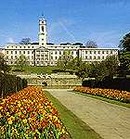
The university underwent significant expansion in the 1920s when it moved from the centre of Nottingham to a large campus on the city's outskirts. The new campus, entitled University Park, was completed in 1928, and financed by an endowment fund, public contributions, and the generosity of Sir Jesse Boot who presented 35 acres (140,000 m2) to the City of Nottingham in 1921. Boot, later named Lord Trent, and his fellow benefactors sought to establish an "elite seat of learning" committed to widening participation, and hoped that the move would solve the problems facing University College Nottingham in its restricted building on Shakespeare Street. Boot stipulated that whilst part of the Highfields site, lying southwest of the city, should be devoted to the University College, the rest should provide a place of recreation for the residents of the city, and by the end of the decade the landscaping of the lake and public park adjoining University Boulevard was completed. The original University College building on Shakespeare Street in Central Nottingham (known as the Arkwright Building), now forms part of Nottingham Trent University's 'City campus'.
Source & More Information: Wikipedia, University of Nottingham, http://en.wikipedia.org/wiki/University_of_Nottingham