



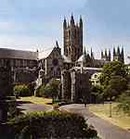
Canterbury Cathedral in Canterbury, Kent, is one of the oldest and most famous Christian structures in England and forms part of a World Heritage Site. It is the cathedral of the Archbishop of Canterbury, leader of the Church of England and symbolic leader of the worldwide Anglican Communion. Its formal title is the Cathedral and Metropolitical Church of Christ at Canterbury.
The cathedral's first archbishop was Augustine of Canterbury, previously abbot of St. Andrew's Benedictine Abbey in Rome. He was sent by Pope Gregory the Great in 597 as a missionary to the Anglo-Saxons. Augustine founded the cathedral in 602 and dedicated it to St. Saviour.
Archaeological investigations under the nave floor in 1993 revealed the
foundations of the original Saxon cathedral, which had been built
across a former Roman road.
A pivotal moment in the history of Canterbury Cathedral was the murder of Thomas Becket in the north-west transept (also known as the Martydom) on Tuesday 29 December 1170 by knights of King Henry II. The king had frequent conflicts with the strong-willed Becket and is said to have exclaimed in frustration, "Who will rid me of this turbulent priest?" The knights took it literally and murdered Becket in his own cathedral. Becket was the second of four Archbishops of Canterbury who were murdered.
Source & More Information: Wikipedia, Canterbury Cathedral, //en.wikipedia.org/wiki/Canterbury_Cathedral